Ground between two stones, slowly, so it never gets warm.
A granite mill turns about thirty times a minute and produces roughly forty grams of matcha in an hour. Push it faster and the friction warms the powder, and the aroma leaves before it ever reaches you. There is no way to hurry this, which is most of why good matcha costs what it does.
Saga no Mukashi comes from Tagashira Chaho, a family tea house in Uji, in the hills south of Kyoto, working there since 1930. First harvest, picked by hand.
It is graded for koicha — thick tea, where the powder is kneaded with a little water instead of whisked into foam. That is more than an everyday bowl needs, and you will taste where it goes: less astringency, more sweetness, a finish that stays after you put the bowl down.
What it is
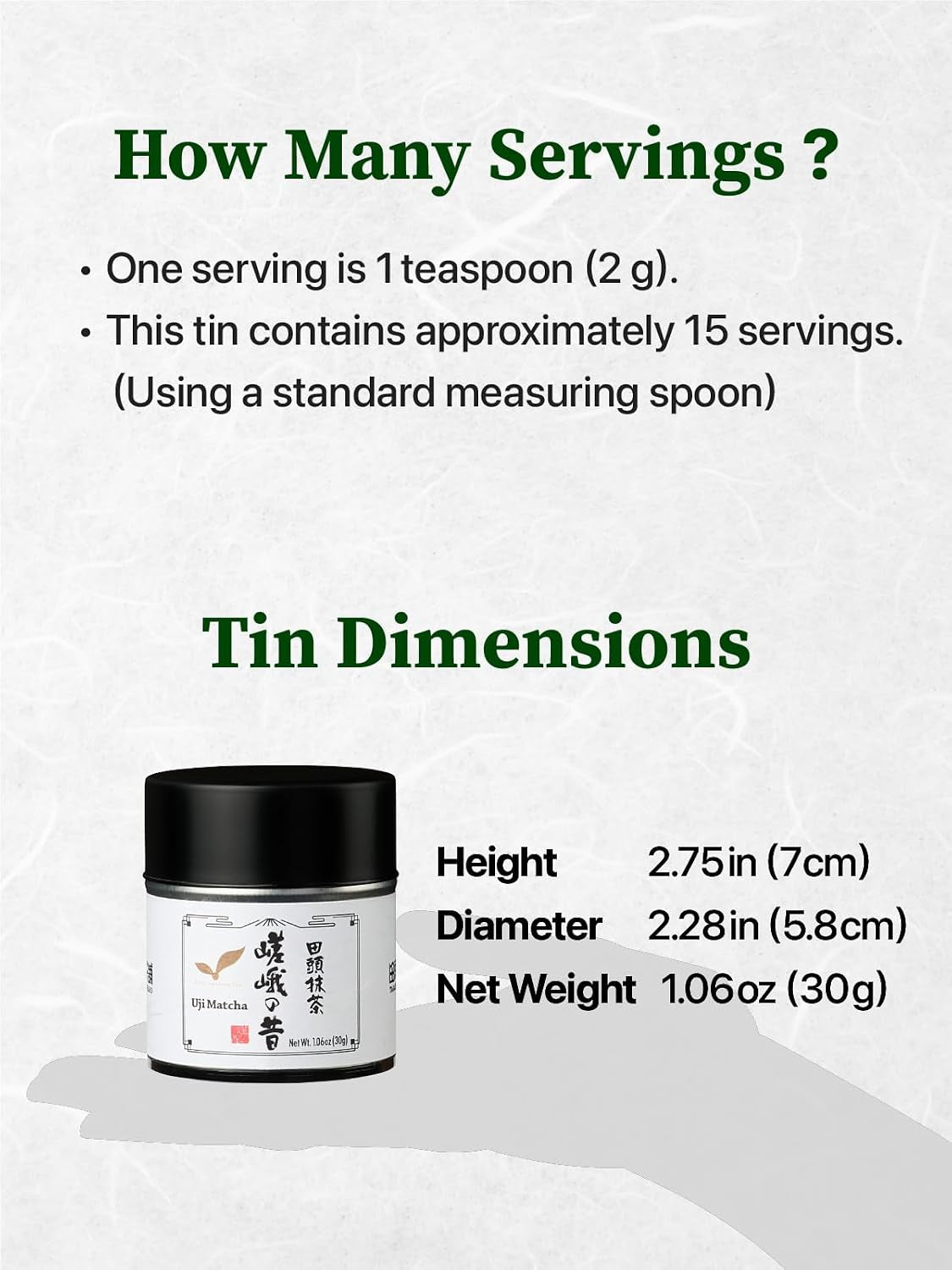
30 g (1.06 oz). Roughly twenty bowls of usucha, or ten of koicha.
100% product of Japan. Uji matcha, first harvest, stone-milled. Nothing added.
How much to use
For usucha — thin tea, the everyday bowl — 1.5 g to about 70 ml of water at 70–80°C in summer, 75–85°C in winter. Two scoops of a chashaku, or a light teaspoon.
For koicha, use roughly twice the powder and half the water, and knead rather than whisk. It will look like paint and taste like nothing else.
How to keep it
Sealed, cold and dark. Matcha turns fast once it is opened — the colour dulls and the sweetness is the first thing to go.
A week or two on a shelf is fine. Longer than that, put it in the fridge, and let the tin come back to room temperature before you open it so no moisture gets in.